
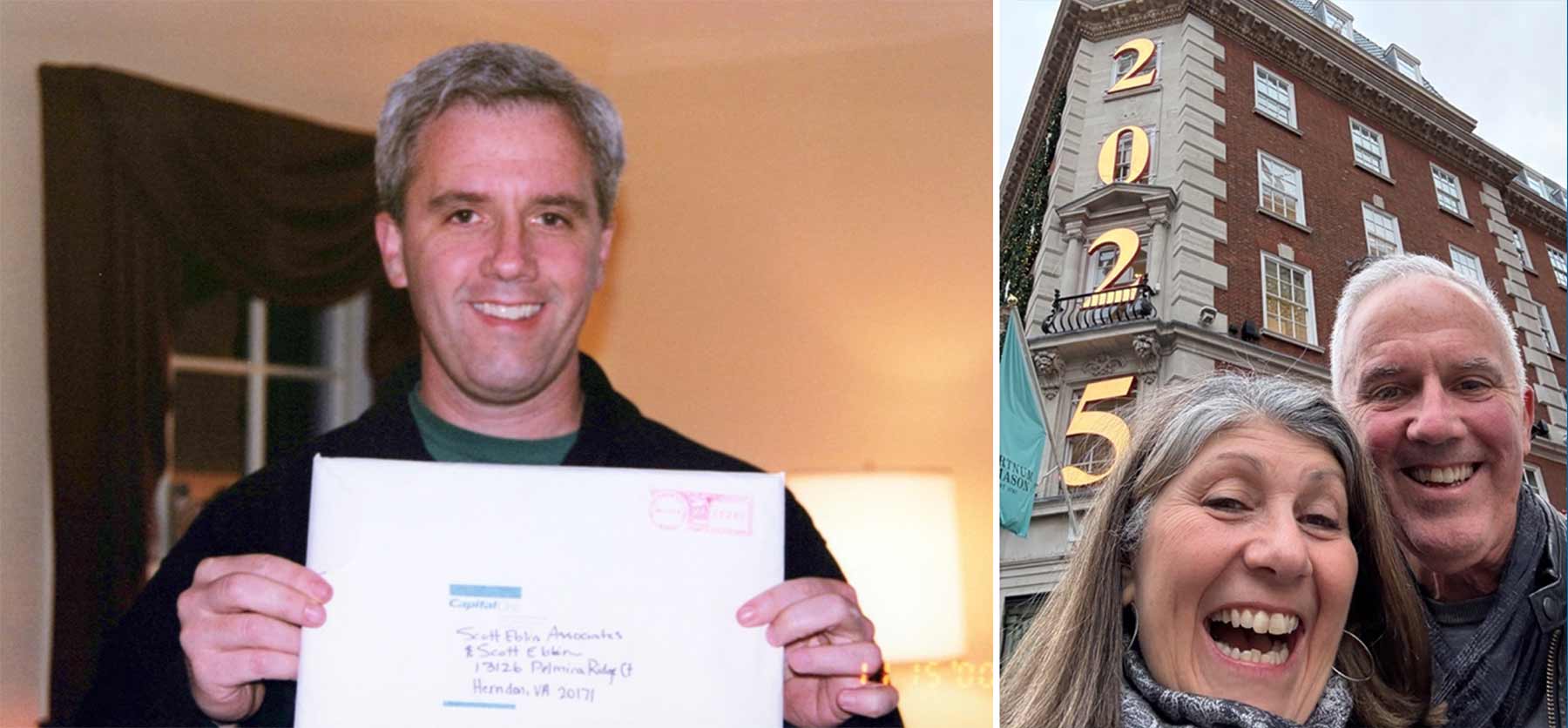
It was 25 years ago this week when Diane Eblin and I hung out the shingle for our executive coaching and leadership development business. Actually, it was a tri-fold brochure since we didn’t have a website yet, and the name of the business was Scott Eblin Associates – the Eblin Group name came online a couple of years later. And, seemingly just like that, here we are celebrating the 25th anniversary of being in business. (That guy in the picture with all the dark hair is me holding up the first client contract we received on December 15, 2000.The accompanying pic of Diane and me is the “how it’s going” update.)
With 25 years in the rearview mirror and what looks like some awesome roads ahead, it feels like a good time to answer some questions about our journey. Specifically,
- What was your original vision vs. where you are now?
- What’s changed?
- What hasn’t changed?
- What’s been easy?
- What’s been hard?
- What’s the secret to growing and running a business together when you’re married?
- What’s next?
Original Vision vs. Today’s Vision
To be completely honest, our vision back in December 2000 was to earn as much as I did in the last year of my corporate job by building on my familiarity with the early days of executive coaching and my experience as someone who had always ended up advising the top executives in the organizations I had worked in in the first 15 years of my career. Through persistence, good luck, and doing the work, we slightly exceeded our year one goal.
About nine months into the business, I had breakfast with a senior coach, the late, great Neil Stroul, who encouraged me to develop my own intellectual property to differentiate myself in the market. I went home and started doodling on a legal pad waiting for inspiration to strike. It was pretty much crickets. Three years and many coaching sessions later, I had the core idea for my first book, The Next Level, which was to outline the behaviors and mindsets that leaders need to pick up and let go of to be successful as they advance in their careers.
The Next Level changed everything for us. Diane and I always viewed the book as one channel for a set of ideas that could be delivered and add value for clients in lots of different ways – 1 on 1 coaching, group coaching, speaking, workshops, 360-degree feedback, discussion guides, videos, online courses, etc. We intended to build our business around the book and that’s what we did.
One of the biggest factors in evolving our vision for the business was completely unexpected – my 2009 diagnosis with multiple sclerosis. As I’ve written here, the first couple of years with MS were pretty rough until I became a regular practitioner of yoga and learned that managing my stress response had an enormous impact on my ability to manage my overall health. That insight prompted me to look at my work with executives in a different way. It led to publishing my second book, Overworked and Overwhelmed, in 2014 and informs a holistic vision of how I approach my work with and for leaders today – when you live better, you lead better. Effective self-management creates the platform for positive leadership outcomes.
What’s Changed?
What’s changed over 25 years? Way too many factors to list so here are three that stand out for us:
Ubiquity: A couple of years ago, the folks at Coaching.com referred to me as a coaching OG when I was a guest on their podcast. I’d never thought about that before, but it’s got a lot of truth to it. When I told people at parties in 2000 and 2001 that I had left my corporate job to be an executive coach, the most common responses I got were blank stares, “What’s that?” and “Is that like life coaching?” Twenty-five years later, no one has to explain what executive coaching is because there are tens of thousands of us (at least).
Time Shifts: In the early 2000’s it was common (and expected) for me to spend 60 to 90 in-person minutes meeting with my clients – usually on a bi-weekly cadence. I know that’s hard to believe (it kind of is for me too) in an era when most of us work in some combination of analog and digital modalities and a lot of executives I know and work with are taking meetings in 15-to-30-minute increments throughout the day. These days, the coaching comes in a mix of phone calls, Zooms, emails, and texts. In-person meetings are reserved for deeper dive pull-ups with each other to note and learn from the patterns of the past several months.
Stress and Distractions: Both higher. The world is a much more challenging operating environment for leaders in 2025 than it was in 2000. I’ve always believed that you have to meet clients where they are and account for what they’re dealing with. As the world has changed, I think more and more of my job is to create the space for my clients (and readers and listeners) to step back, observe the patterns, and determine what’s next. That approach lines up with the definition of mindfulness that I offered in Overworked and Overwhelmed – it equates to awareness plus intention.
What Hasn’t Changed
Success is Defined by the Client: There’s a long running and often dogmatic debate about the difference between coaching and consulting. Our position is it’s the wrong debate. In my experience, the more important question is what’s going to help the client and their organization be successful? If it’s coaching, fire away with the questions that make a leader think, self-observe, notice, and change. If it’s consulting, don’t hesitate to offer your perspective or even an answer. It’s often a both/and, not an either/or.
It’s a Business, not a Practice: We were clear from the jump about who we were serving – business leaders in large organizations. They expected a systematic approach and a professional presentation. We were serving business leaders, so we managed the Eblin Group as a business, not a practice (which is how a lot of coaches referred to their work when we were starting out). We’re not as militant as we used to be on that point, but running a business with sound processes, systems, and practices has been vital to us being around for 25 years.
Relationships Rule: We’ve always viewed our business as one that is built on building long-term relationships. That’s true for the core team of professionals who support us – some of them have been with us for over 15 years. It’s true for our clients – there are client companies we’ve worked with for 20 years and individual executives I’ve worked with off and on for over a decade as they achieve new milestones in their careers. It’s true for the folks who read my books, follow me on LinkedIn, read my blog or listen to my podcast – we’ve always had an anti-spam mantra that the content we share should do two things: raise awareness and add value. We believe that has been a relationship building approach.
What’s Been Easy
Being clear about who we’re here for: I remember the first time I got to speak for GE back in the day, I was sitting in the back of a shuttle bus that was carrying everyone from the hotel to the meeting venue and, as the bus filled with bright-eyed high potential leaders, I thought to myself, “These are my people.” There’s an old piece of advice to writers that you should write what you know. More generally, that advice has been how we’ve grown the business. We knew the challenges facing leaders in large organizations because I had lived that experience myself. The methods and points of emphasis have changed over the years, but the people we’ve been here for remain the same.
Maintaining the voice and approach – Early on, we recognized that both my approach and my voice could be summed up with the words simple, practical, and immediately applicable. Those words have been both my goal and filter in my coaching, speaking, and writing for most of the past 25 years. Your mileage may vary, but those words have been easy to use as a guide in the business because they’re authentic to me and they appeal to the leaders I work best with.
Bringing the joy – There’s a great line from Friederich Buechner that (paraphrasing here) joy is found when your great passion intersects with the world’s great need. That’s how it’s been for us in our work over the past 25 years. For me, that’s looked like bringing my lifelong passion for strategy and leadership and personal development to the work I do with high talent leaders who are seeking to live better and lead better. For Diane, it’s been using all of her skills to build a kick-ass business that makes a difference for people and changes lives.
What’s Been Hard
Building a business ain’t easy: We wouldn’t want to leave with you the impression that building our business over the past 25 years has been a straight up and to the right journey. There have been dips and uncertainty along the way (see the point about pivoting below) that required tenacity, belief, unwavering partnership, and the quality of being what became our favorite word – relentless.
Pivoting: It hasn’t exactly been hard for us to pivot when necessary, but you have to be ready and willing to do it when you need to do. Just think about all the externalities – 9/11, the 2008 financial crisis, COVID, DOGE – in the last 25 years that have led to pivots for successful businesses and failures for ones who didn’t. You’ve got to be ready to make some moves. For instance, when COVID hit in March 2020, our projected billings for the rest of the year literally went to almost zero as clients cancelled all the in-person programs and speeches we had booked. We pivoted by quickly cutting a new highlight reel that emphasized virtual delivery using old footage, new B roll Diane shot on an iPhone, and a new voice over that I recorded surrounded by pillows underneath a table with a sheet draped over it. We released it in early April. That video combined with the relationships we had built over two decades saved our year.
Easier to build a platform when you already have one: Back when I was writing The Next Level and Diane and I were thinking about how to get it out to the world, we kept reading and hearing about the importance of having a platform. We quickly learned that it’s easier to build a platform when you already have one. We didn’t, so we got to work on building one. It reminds me of that old question about what’s the best time to plant a tree. The first best answer is 20 years ago. The second-best answer is today. To the degree that I’m known in the world as an executive coach, author, educator, etc., it’s been because we’ve been relentless (see above) about raising awareness while adding value (also see above). The work of building a platform never ends – we’re still doing it now as we build an audience for my podcast, Best Ever and our online life and leadership courses.
Marriage and Business Lessons
One of the most frequent questions Diane and I have gotten over the years is how do you run a business together and stay married, let alone having a happy marriage? The first part of my answer (maybe not hers!) is marry a super multi-talented person who you love hanging out with. Then, once you’ve done that, keep a few rules in mind like:
It ain’t personal, it’s business – You can disagree about business decisions without bringing the disagreement to the dinner table.
Play to each other’s strengths – I’ve said for years that when it comes to the business, I’m the face (even though she’s way better looking than me) and Diane’s the brains. My strength is understanding and coaching in the client’s world and creating content for leaders. Diane’s are multitudinous but some of the key ones are creating processes and systems, keeping our team (and me) on track, and marketing. If I do say so myself, we’ve been an awesome team in 25 years of business and 38 years of marriage.
It’s about collaboration, not competition – We’ve never felt the need to compete with each other. We recognized early when we celebrate each other’s strengths and collaborate, we win together.
Invest time in the marriage without the business sneaking in – It can be easy to let the business you’re running together take over your marriage and life. We realized about five years into our marriage that we needed to be deliberate about date nights, occasional trips without our kids, and taking an annual retreat together to create the marriage and family we envisioned. Having eight years of reps with that approach under our belts before we started the business paid enormous dividends that compounded as we sustained those routines.
What’s Next?
So, what’s next for us and the Eblin Group? As I’m reminded of the old line about man plans and God laughs, the honest answer is, “Who knows?” I can, however, tell you what our intentions are, and they’re based on an idea I’ve learned in the last couple of years from the author, Arthur Brooks.
One of his main points is that over the course of our life, most of us graduate from fluid intelligence in our younger years to crystallized intelligence in our later years. Another way to put it is like the guy in the Farmers’ Insurance commercials, “He knows a few things because he’s seen a few things.”
That’s what we envision for the Eblin Group in the coming years, building on the crystallized intelligence formed over the past 25 years to support leaders in living better and leading better. From our current vantage point, that looks like high leverage coaching engagements with C-Suite leaders, digital courses and programs to support high potential leaders, and written and spoken conversations through my books, online presence, and podcast, to support leaders and anyone else interested in how effective self-management can be the foundation for positive outcomes not just at work, but at home, and in your world in general.
If you’ve read this far, good on you, and thank you. Thank you not just for reading but, from Diane and me both, for the role you’ve played in making 25 years in business simply amazing.
If you liked what you read here, subscribe here to get my latest ideas on how to lead and live at your best.